Showing posts with label Android. Show all posts

Friday, 28 June 2013

Android 4.2.2 for Galaxy S3 Firmware Leaked, Download it Now

The Android 4.2.2 update for the Galaxy S3 has leaked online ahead of its official release date – and you can download it here! To note: there have been Android 4.2.2 update leaks in the past, but this is the most complete yet.
galaxysthreeupdateokay
Samsung Galaxy s3's Android 4.2.2 update features a lockscreen with a new "light effect"/ © SamMobile
SamMobile is the first site to get its hands on I9300XXUFME7 - Android 4.2.2 Jelly Bean test firmware for the Galaxy S III. It includes a number of software enhancements, like a new Galaxy S4-esque lock screen, support for multiple widgets, an additional "light" unlock effect, improved ripple animation and the ability to change the clock size and post a personalized message. 
According to SamMobile, the official update can be expected in July or August, although we don't yet know for sure. Previously, SamMobile reported that the final version was supposed to be released in June.
This new firmware also features Adapt Display mode which optimizes colors based on ambient light conditions, a new Daydream mode, actionable notifications and the addition of voice control settings. Not only can you see a video of the update in action, read about all of its features, but you can also flash it on your device!

Android 4.2.2 Build ID: JDQ39 Features:


- New S4 Lockscreen: Multiple Widgets, two Unlock effects (Ripple and Light), improved ripple effect than Android 4.1.2, ability to change clock size and set a personal message
- New Screen modes (From S4): Adapt Display and Professional Photo
- Daydream
- Driving mode
- Actionable notifications
- New Additions in Notification Center
- Completely revamped Settings UI (Tabbed interface – Exactly like the S4)
- Addition of Voice controls (Let’s you control various parts of the phone using voice commands – Galaxy S4 feature)
- Gallery modes have white background (When changing gallery modes to 3D the background changes to white)
- Full screen Samsung apps
- New S-Voice (from S4)
- New smart switch widget
- Found more? Tell us about them in the comments below!

Here are the full firmware details:


Android Version: 4.2.2 – JDQ39 (Jelly Bean)
PDA: I9300XXUFME7
CSC: I9300OXAFME7
MODEM: I9300XXUFME7
Region: Open Europe
Carrier: Unbranded
Changelist: 702147 (Previous leak: I9300XXUFME3 = 611730)
Build Date: 21 May 2013

Here's What it Looks Like On Video:


Finally, here's how to download and install the update on your device (warning: it involves wiping your device):


  • Download the firmware here.
  • Unzip the file
  • Open Odin 3.04 (already included in the firmware package)
  • Restart phone in download mode (Press and hold Home + Power + Volume down buttons)
  • Connect phone and wait until you get a blue sign in Odin
  • Add I9300XXUFME7_I9300OXAFME7_I9300XXUFME7_HOME.tar.md5 to PDA
  • Make sure re-partition is NOT ticked
  • Start flash, sit back and wait a few minutes.
  • If you encounter any issues with the firmware (Any FC, Bootloop etc)
  • Boot into recovery mode (Home+ Power + Volume Up)
  • Choose to wipe/factory reset. (THIS WILL ERASE ALL OF YOUR DATA INCLUDING YOUR INTERNAL SD CARD!)
  • Then choose reboot and you should be good to go!

UPDATE: Blackberry Messenger coming to your Android this summer

Hot off the heels of the BlackBerry Live developer’s conference that happened today a version of BlackBerry Messenger for Android and iOS has been announced. Later this summer, the new service will be offered free of charge.
bbm
The BlackBerry Messenger, BBM for short, is considered very popular and handy tool among BlackBerry users and has often been praised for its safety and reliability. As of this summer, there will be a version of BBM ported over for iOS and Android, with planned updates for advanced features such as group chat, split screen and channels.
As a provider of business solutions, Blackberry is especially keen on security and this would be a driving point that would help score points with users across the different operating systems. However, will Blackberry and BBM have what it takes to take on established services such as Whatsapp? Only time will tell.
What do you think? Is this something that will sway you away from Whatsapp and similar messaging apps?
UPDATE on June 6th, 2013: 
Confirmation of the date that Blackberry Messenger will be arriving to Android and iOS devices has dropped on T-Mobile UK's twitter page. Users of both operating systems can look forward (?!) to trying out the popular messenging service on June 27th, so just three weeks away.
bbmessage
Users will need to be running Android 4.0 and higher or iOS 6.0 to be able to use Blackberry Messenger on their device. While it's been a long time in coming, the once ridiculously popular messenging application that was unique to Blackberry devices faces strong competition against the likes of Whatsapp and Viber.

Leef Bridge: USB Flash Drive for Android Devices, PCs and Macs

Leef Technology out of California have just released the Leef Bridge, a funky new USB Flash Drive for sharing between Android phones and tablets, PCs and Macs – a first. It's a devastatingly simple idea: carry around the tiny lighter-sized, slidable flash drive in your pocket and transfer files between devices without cables, batteries, Wi-Fi, Bluetooth or cloud services. You can also play music and video direct from the flash memory meaning transferring from one device to another isn't even essential.  
LeefBridge1
The new Leef Bridge is a USB flash drive for easy data sharing between Android devices and computers 

Functionality

The device we tested performed exactly as expected, although the transfer speeds were less than remarkable. Transferring to and from devices was very easy (simply copy and pasting), and playback from flash memory was seamless. The fact that the one device can be used to copy pictures, music, video and documents from any of your devices and transferred or played back on any other device is beautiful in its simplicity. Cameras, smartphones, tablets, desktops, easy.

Design

Like most slidable USB drives, the Leef Bridge is a little larger than most other flash drives, but considering it houses a USB and micro-USB connection that's still pretty impressive. The main body is the size of a stack of postage stamps with a lockable sliding cover that exposes one connection or the other, or protects them both. It's simple, functional and it works.
LeefBridge2
The Leef Bridge works straight from the box with no cables, cloud, Wi-Fi or Bluetooth 

Ease of Use

I tried the Leef Bridge with a Samsung Galaxy S3 straight out of the box and it worked perfectly. The included instructions recommended downloading the Astro File Manager app to your mobile device but this wasn't necessary for me. Once it's plugged in the file manager is launched automatically. You can easily transfer files to the device and then either plug and play direct from the shared flash memory to your tablet, laptop or desktop, or transfer the loaded files as you normally would with a standard USB flash drive.

Compatibility

Leef Bridge requires Android Jelly Bean OS 4.1 or later for smartphones and Android tablets, it also works on Win 8 tablets and is of course Mac and PC compatible as a standard USB flash drive. The company's website features a full list of compatible devices that also includes Samsung Galaxy cameras, meaning you could pull photos direct from your camera without having to remove memory cards. The website also claims compatibility with the Samsung Galaxy S4 running Android 5.0? The Leef Bridge currently comes in 16GB and 32GB, and in the near future 64GB.
LeefBridge3
Transfer and share files between camera, smartphone, tablet and computer 

Tech Specs

Device Leef Technology Bridge (USB flash drive)
Capacities 16GB, 32GB, 64GB (in coming months)
USB 2.0 (Full Size and Micro-USB)
OS Android 4.1 or later
System Requirements Supports Windows® 8, Windows® 7, Windows® XP (SP3), Windows Vista® (SP1, SP2), Windows 2000®, Linux Kernal 2.6 or later, Apple® Mac OS X or later
Color Black
Dimensions 23.8 x 56.2 x 9.6 mm
LeefBridge4

Conclusion

While the USB 2.0 transfer speeds are far from blistering (in my tests between 4.1 – 5.1 MB/s) – a short 225 MB video took between 44-55 seconds to transfer – there were no lags in playback when video or music was run direct from the flash memory. The device quite simply does what it claims to do and as long as you don't need to transfer files at high speed, this little gadget simplifies what otherwise can be a fidgety, occasionally irritating task. And that suits me just fine.

Android powers 59% of smartphones, tablets, and laptops says Canalys

New reports indicate that mobile platforms are continuing to dominate the market and that the Android is the go to operating system for over half of the devices out there.
An iOS Win
The independant technology analyst firm, Canalys, released findings recently that exposed Android devices account for around 59% of all smartphones, tablets, and laptops currently on the market. According to the report, mobile computing device shipments grew by about 37% in the first quarter of 2013 which amounted to almost 309 million devices.
Out of this increase, which included a pool of smartphones, laptops, and tablets, tablets were found to be the fastest growing segment out of the bunch. In this report, Canalys senior analyst Tim Coulling suggest that sales of tablets were continuing to increase due to lower expectations of the devices when they were first released: "Spearheaded by Google and Amazon, the commoditization of the tablet market has happened far quicker than that of the wider PC market."
Included in the report was speculation behind the lagging growth of Apple's iPhone sales compared to that of rival manufacturers, mainly residing in what Pete Cunningham, another analyst at Canalys, described as an aging UI and increased fierce competition by HTC and Samsung:
But HTC and Samsung have raised the bar with their latest handsets and Apple needs to respond with its next iPhone. The iPhone user interface is now six years old and badly in need of a refresh. Hardware-wise, the biggest dilemma that Apple faces is what it does with the size of the display on the next iPhone. It cannot afford to ignore the trend for larger displays in premium smart phones.
All in all, Android remains on top of all smart mobile devices with a dominant market share of 59%. Apple placed second with 19.3% percent with Microsoft trailing closely behind at 18.1$.
With a surprising lead over competitors Apple and Microsoft, it seems like it's full steam ahead for Android and Google. However, the company should take note of it's own hubris and continue the innovation and creativity it has been known for. Not long ago, both Apple and Microsoft had spent time atop the podium.

ATIV Q: Windows and Android under the same house

At their London event, Samsung announced their ATIV Q tablet, which runs both Android and Windows that can switch seamlessly between the two operating systems. Will the battle between Android and Windows end peacefully with this merger? I’ve been testing this hybrid tablet out.
ativ q 6
Windows left, Android right. The ATIV Q can do both simultaneously. / © AndroidPIT

A multitalented tablet

If one pops up the flat screen of the ATIV Q, a keyboard is revealed which transforms the 13.3-inch tablet into a veritable small notebook. The display can also be rotated so that it floats horizontally above the keyboard; a useful setting to be used when drawing on the screen and interchanging between using the keyboard, notes Samsung. The operation with Samsung’s S Pen (known for its use in the Samsung Note series) is fluid and smooth. The resolution on the screen is great as well: the 13.3-inch qHD+ display sports a 3200x1800 pixel resolution with a pixel density of 275.
ativ q 2
One of the many configurations of the ATIV Q, display hovering over the keyboard. / © AndroidPIT
The ATIV Q shines not only as a high-class display, but also from its design and hardware. The processor is housed in the base of the device and connects the display with the keyboard, the battery is installed in the lower keyboard, and the display contains only the screen and sensors, making it ridiculously thin.

“Both:” instead of “either or”

Windows 8 and Android 4.2.2 are both installed on the device and run in parallel. Just tap the Home button (on the ATIV devices, it’s the Windows key) and you’re being switch between the two. Both systems can also be displayed simultaneously in a split-screen view.
ativ q 1
Windows 8..../ © AndroidPIT
ativ q 4
.....or Android 4.2.2. / © AndroidPIT
I was surprised at how smoothly and seamlessly you can switch between the two systems.  Whether the Intel Core i5 processor is capable of handling computational hungry programs running in the background at the same time as having two operational systems is another story, but the short time I had with the ATIV Q really impressed me.
Although Samsung advertises that you can “enjoy” Android Apps on Windows, the technology behind it is less than spectacular. Folders and data between Windows and Android an be moved back and forth, the same as that can be done via the ATIV Q and an Android Device using a service called Samsung SideSync.
Nevertheless, the concept of the ATIV Q is very interesting. As soon as we get a hold of a tester of the device here at AndroidPIT, we will be able to discuss the Windows/Android hybrid again in more detail.

Thursday, 27 June 2013

Google Search Android App Updated, Allows Voice-Activated Music Playback


Google has released some sweet new features for its Google Search app for users who are running Android 4.1 or later on their devices. Here’s what’s new:
  • Information about shows you’re watching on your internet-connected TV (US only)*
  • Saved offers when nearby a redemption location
  • New voice action: play music from your phone or the Play Store
  • Voice actions tips
  • *Requires phone/tablet to be on the same network as your TV
Now users can search and play music via voice commands on their devices, and will be notified of saved offers when in proximity to a redemption location. Look for the update to be hitting your device soon, or head over to the Google Play Store to grab the update.

Wednesday, 26 June 2013

Telefonica To Give Windows Phone 8 An Extra Push To Try To Dilute Android, iOS

700-nokia-lumia-920-yellow-portrait
Microsoft continues to throw money down the Windows Phone well, perhaps buoyed by signs its ongoing marketing and platform support efforts are shifting the needle a few fractions. Today more evidence — presumably— of Ballmer’s money-throwing commitment to make its smartphone OS stick: carrier Telefonica has announced it will be collaborating with Microsoft to “promote and foster sales” of Windows Phone 8.
Microsoft has been shelling out to pay developers to port their apps to WP8, as it plays app catch-up with the rival Android and iOS ecosystems. It’s unclear exactly how much cash Redmond has paid out on this, or on WP8 marketing in general, but it’s currently running a promotion for which developers can get $100 per app submitted up to a maximum of $2,000 each if they submit a stack of apps.
Flagship apps — such as Angry Birds — are likely to have commanded much larger payouts to be ported over of course. WP8′s lowly marketshare means it’s likely not worth such developers’ while to support the platform. Or at least not without the sweetener of a substantial cash incentive.

Meanwhile Instagram, another big name app that still stands aloof of the Windows Phone ecosystem, has apparently been offered millions of dollars to port the app by Microsoft and Nokia. For whatever reason, it’s one app WP8 still lacks however.
Returning to the Telefonica-Microsoft love-in, the pair say this new “enhanced” marketing effort will initially run for a year, and will be targeted at six markets where Telefonica carrier brands operate: namely the U.K., Germany, Spain, Mexico, Brazil and Chile. These markets appear to be ones where Microsoft’s OS has already managed to generate a little marketshare momentum. According to earlier Kantar data, for the three-month period ending February 2013, Windows Phone had a 6.7% share in the U.K., 6.8% in Germany and 5.9% in Mexico, for instance.
Telefonica declined to answer questions about how much money — its own and/or Microsoft’s — will be poured into this enhanced marketing effort, saying the information is confidential. The only question it would answer is which Windows Phone device is the biggest seller in most of its markets — and that device is the Nokia Lumia 920. Microsoft also declined to comment further.
It’s possible Microsoft is bankrolling the entire enhanced marketing program itself, although Telefonica says its motivation in helping to promote WP8 is to diversify the devices it offers to consumers and “improve the current balance of mobile operating platforms on the market, encouraging it to be more diverse and less of a duopoly”. For duopoly read: Android and iOS.
Why would a carrier want to encourage more diversity? Surely that just means creating more work and outlay for itself as it has to train its staff to sell different types of phones? There are plenty of reasons. With Android so dominant, power over development and direction of the mobile landscape is increasingly concentrated in Google’s hands. Carriers would obviously prefer they hold more of the cards, so that they can push their own over-the-top services to build the new revenue streams they need to as their traditional moneyspinners (talk and text) continue to decline.
Plus, if most of the phones run the same OS, there’s less incentive for consumers to buy a new device. Pushing customers to switch to something new is arguably a more compelling upgrade sell for carriers to foist on their customers now that smartphone hardware has become so similarly capable. A different OS — and WP8 does certainly look different to the two market leaders — gives them something new to try to pull the punters in. This is especially important in saturated markets like Europe where smartphone penetration (and Android usage) is so high.
Telefonica said it will be working with suppliers and WP8 mobile makers to “ensure the availability of high-quality devices” and “make their commercial offering available throughout the duration of this enhanced marketing effort with Microsoft”.
Smartphone market figures for Q1 released by analyst IDC yesterday named Windows Phone as now the third biggest smartphone OS in Europe, behind Android and OS, with a two percentage point increasing taking its share from 4% in Q1 2012 to 6% in Q1 this year. Despite being third, it is still very far behind, with Android hugely dominant — with a massive 69% share — while Apple’s iOS share shrunk to a fifth (20%).

Microsoft licenses 'Age of Empires' for iOS and Android, but downplays further releases

Age of Empires

Microsoft is bringing its games to iOS and Android, beginning with Age of Empires sometime in 2013, reports Japan’s Nikkei business daily. The ports are coming courtesy of mobile developer KLab, which is licensing the games from Microsoft for global distribution. Nikkei calls it a possible indication of a turning point in the gaming market, speculating that the move could even affect the mobile strategies of competitors Sony and Nintendo.
However, Age of Empires won't be the first time Microsoft has brought one of its games to the iPhone. That honor belongs to Kinecti mals, which came out back in 2011. Microsoft hasn’t abandoned the platform either, releasing Twisted Pixel’s Ms. ’Splosion Man just three months ago. And while fans might be clamoring for iOS and Android ports of Halo,KLab isn’t exactly a top-tier mobile developer. It lists a dozen native titles for iOS and Android on its website, none of which inspire much confidence in its ability to tackle a big project.
What’s more likely to be happening is that Microsoft is making a little money on the side by licensing one of its under-utilized franchises to a third-party developer. And while Nikkei reports that more collaborations between KLab and Microsoft will be forthcoming, Redmond doesn't sound quite so enthusiastic. A Microsoft representative tells us that "some reports included incorrect information about additional Xbox Live-based games on iOS and Android but there are no further announcements beyond Age of Empires at this time.
"

Peloton’s Android exercise bike with a 21.5-inch screen raising money at Kickstarter

Peloton's Android exercise bike with a 21.5-inch screen raising money at Kickstarter

We’ve seen a number of different Android devices, including phones, tablets, cameras, TVs and set-top boxes. Like that’s not enough, now we have an exercise bike relying on Google’s mobile platform raising cash and awareness at Kickstarter.
The Peloton Bike has top notch specs, including:
  • Frame: Carbon steel and aluminum monocoque construction
  • Resistance: Neodymium rare earth magnet resistance system
  • Drive: Poly V power transmission belt drive
  • Pedals: LOOK Delta compatible thermoplastic pedals
  • Seat: Sport series saddle with depressed ergonomic center channel
  • Crank arms: 170mm carbon steel
  • Bottom bracket: Precision steel 13/68mm
As for the brains part, there’s a 21.5-inch full HD touchscreen running Android 4.1. Inside that big-ass display, you have TI’s OMAP 4470 dual-core processor clocked at 1.5GHz, 1GB of RAM, wired (Ethernet) and wireless (Wi-Fi + Bluetooth) connectivity, stereo speakers, 1.3-megapixel camera, and all the software an exercise fan could need (with the ability to install even more apps).

Tuesday, 25 June 2013

Android-powered Garmin Monterra is a powerful, expensive outdoor GPS with Wi-Fi

Android-powered Garmin Monterra is a powerful, expensive outdoor GPS with Wi-Fi

Garmin announced a new Android device called Monterra. It’s not a smartphone, but a Wi-Fi enabled outdoor GPS unit featuring the company’s powerful location and mapping capabilities.
Inside, it packs GPS + GLONASS alongside other sensors like 3-axis compass with accelero meter and gyro, as well as barometric altimeter to track changes in pressure to pinpoint precise altitude, and monitor weather conditions.
In addition, there’s also a highly durable 4-inch mineral glass transflective display and even an 8-megapixel camera with LED flash for taking photos, along with 6GB of expandable storage (using microSD cards).
Perhaps more importantly, Monterra is fully ruggedized and has an IPX7 waterproof rating, and (the best part) can be powered both by a built-in Li-ion battery or traditional AA batteries. Pretty darn cool when you’re out of power.
When it comes to connectivity options, Garmin’s baby has Wi-Fi, ANT+, Bluetooth 3.0 and NFC capabilities, allowing users to share data, maps, waypoints, tracks, routes and geocaches with other wireless devices. Additionally, Monterra is compatible with BaseCamp, a free software that lets you view and organize maps, waypoints, routes and tracks.
The Garmin Monterra will be available in Q3 2013 at a recommended retail price of £599.99 (about $927) with preloaded Rec Map Europe with Navteq roads. Kinda expensive though I guess “outdoor professionals” won’t mind spending an extra few grands for this kind of device…

Monday, 24 June 2013

Device Shipments Up 6% To 2.4B In 2013, Driven By Android Smartphones, Tablets Amid More PC Decline

android_series01Gartner today has released its latest figures charting its overall predictions for how IT devices — from PCs to mobile handsets — are going to perform this year and in 2014. As in years before, numbers will continue to climb: in 2013, total shipments will rise 5.9% to 2.35 billion, and will rise again in 2014 to 2.5 billion units, driven by portable, often less expensive, but just as powerful mobile devices such as smartphones and tablets. Android will account for just over one-third of all devices this year, and nearly half in 2014. It’s an Android world after all.
But continuing a trend we have been seeing for some time, personal computers — which kicked off the technology love affair for consumers — will not be the hardware reaping the most benefits from that growth. PC shipments will decline this year to 305 million units, Gartner says, before dropping again in 2014 to below 300 million (289 million).
Mobile devices will continue to replace PCs as consumers’ primary computing device, leading with smartphones, which will continue to be the most popular IT device sold. The 1.8 billion units in smartphones that that Gartner estimates will be shipped this year equates to about six times the number of PCs. And while tablets are still far behind both at only 201 million units, they will be growing the fastest, up some 68% on 2012. In comparison, mobile phone growth is 4.3%, actually slower than the overall average of 5.9%. And this is far from being a simple first-world trend or emerging market trend:
“Consumers want anytime-anywhere computing that allows them to consume and create content with ease, but also share and access that content from a different portfolio of products,” writes Carolina Milanesi, research vice president at Gartner. “Mobility is paramount in both mature and emerging markets.”
“Shipments”, as we’ve pointed out before, refers to devices sent to channels for sales. Some analysts use the term interchangeably since these are estimates; and they are an important barometer for how sales are proceeding and users are moving. Indeed, in an example of shipping estimates at work, Gartner notes that the “sharp decline in PC sales recorded in the first quarter was the result in a change in preferences in consumers’ wants and needs, but also an adjustment in the channel to make room for new products hitting the market in the second half of 2013.”
The “ultramobile” group is an odd one and it will be interesting to see how this evolves. This is Gartner’s preferred term for the neither-here-nor-there category of hardware that includes devices like Chromebooks, tablet/PC hybrids and non-traditional “phablets”, and Gartner’s guess is that whatever impact they will have on sales will be to the detriment of tablets rather than PCs or smartphones:
“The increased availability of lower priced basic tablets, plus the value add shifting to software rather than hardware will result in the lifetimes of premium tablets extending as they remain active in the household for longer. We will also see consumer preferences split between basic tablets and ultramobile devices,” writes Ranjit Atwal, research director at Gartner. Specifically, in Q4, he notes that ultrabooks will hit the market built with Windows 8.1, equipped with new Intel processors Bay Trail and Haswell.
In any case, ultramobiles’ impact will be minimal for now. Out of the 2.35 billion devices shipped this year, only 20 million will be ultramobiles.
Perhaps more to the point will be the fact that cheaper smartphones and tablets will see another kind of pressure: the growth of software that will extend the life of these devices, which will mean users will be less inclined to spend money upgrading them.
“The increased availability of lower priced basic tablets, plus the value add shifting to software rather than hardware will result in the lifetimes of premium tablets extending as they remain active in the household for longer,” writes Atwal.
gartner devices shipments 2013-14
When it comes to platforms, there aren’t many surprises here. Android — which has been dominating the computing industry for a while now with very ubiquitous smartphones running on Google’s OS — will continue to ride that wave. This year there will be 866 million Android units shipped — or roughly one-third of all the devices that will be sent out for sale. Android devices will continue their climb, at a rate faster than that of overall devices. They will hit the billion-unit mark in 2014, with 1.06 billion Android-powered units, equating to just under half of the 2.5 billion devices sold that year.
gartner devices platform 2013-14
As you can see from the figures above, Apple is not winning in terms of having the most ubiquitous platform — and it’s not even a close second contender. But interestingly, Gartner points out that it is the most successful at achieving a cross-device ecosystem.
“Although the numbers seem to paint a clear picture of who the winner will be when it comes to operating systems (OS) in the device market, the reality is that today ecosystem owners are challenged in having the same relevance in all segments,” writes Milanesi. “Apple is currently the more homogeneous presence across all device segments, while 90 percent of Android sales are currently in the mobile phone market and 85 percent of Microsoft sales are in the PC market.” What she also didn’t note is that while Samsung is the strongest in smartphones, there are dozens more making Android devices, and in PCs the picture is much the same. This points to how Apple may be better positioned to capitalize on making the best margins not just on their hardware, but also on the services that they lock consumers in to using across all of it.
Samsung, it should be pointed out, is a strong contender in all these categories as well, so it will not be surprising to see it making moves to offer more services that tie in their different devices together. The question remains, though, whether companies like Microsoft and Google who have been so far strongest in software will try to expand that more into hardware. Results so far have been mixed.

The Ascend P6 is Huawei's latest attempt at a flagship Android smartphone

Ascend p6Huawei is in London today launching its new smartphone, the Ascend P6. The first thing you'll notice about the P6 is it's incredibly thin — Hauwei says it's 6.18mm thick, which is far thinner than Apple's iPhone 5 or the Samsung Galaxy S4. Huawei also claims it's the "world's thinnest" smartphone, but as is often the case with such titles, that achievement is set to be eclipsed by another Chinese competitor soon. The Ascend P6 is pretty light: at 120g, it weighs 10g less than the Galaxy S4. Despite its small shell, Huawei has managed to squeeze in what are essentially the internals of the LG Nexus 4. There's a 4.7-inch 1280 x 720 LCD with in-cell touch, an unspecified 1.5GHz quad-core processor, 2GB of RAM, a 2000mAh battery, and 8GB of internal storage (expandable via a microSD card slot).
Compared to Huawei products we've seen in the past, the Ascend P6 is definitely a step up in quality. Available in black, white, or pink, it's constructed mostly from plastic and doesn't feel cheap, but it's not exactly premium either. The sides are made from aluminum and have an antenna notch that'll be familiar to anyone that's seen an iPhone in the past three years. One odd facet of the design is the corners, which are rounded much like most smartphones at the top, but at the bottom curve round to meet the back of the phone. It's an strange design decision — the two styles don't work particularly well together in my opinion. Another niggling aspect of the design are the device's power and volume controls: they're a little too shallow, and there's no comforting "click" when you press them. Apart from that, everything seems well put together, and the display is good enough — it looks almost identical to the Nexus 4's screen.
Dsc02161
THE CAMERA SOFTWARE HAS A 'BEAUTY LEVEL' SLIDER TO MAKE YOU MORE ATTRACTIVE
Huawei is making noise about the P6's photographic abilities. The rear-facing camera has a backside-illuminated 8-megapixel sensor and an f/2.0 lens. Huawei says the camera can shoot close up photos from as little as 4cm (about 1.5 inches) away. Its front-facing camera is also pretty special, on paper at least: it's a 5-megapixel unit, far higher than most smartphones. Huawei has equipped the front-facing camera with "Auto Face Enhancement," which comes with a "beauty level" slider that can apparently make you more attractive in your self portraits. When I tried it out, all it seemed to do was blur my face slightly and make my cheeks a little more red.
Beautylevel10
We took a few quick shots with the P6 and found the camera to be fairly capable. It definitely can't compete with Nokia's Lumia 920, and falls short of the iPhone 5 and HTC One, but from my brief time with it I could see myself using it regularly without too much issue. The same can't be said for Huawei's Android skin, unfortunately. Called the "Emotion UI," it's based on the latest version of Android, 4.2.2, but it's a pretty heavy skin that feels like an attempt to ape Samsung's love-it-or-hate-it interpretation of Google's OS.
Ascendiphone6
There are a few good ideas in the skin, though, not least of which are granular controls over notifications and data access. Much like iOS' centralized settings for Notification Center, you can stop any app from creating notifications, and you can also prevent apps from using your mobile data. Another thing the skin has over HTC's and Samsung's efforts is the inclusion of on-screen buttons, so at least there won't be any irritating on-screen menu prompts within apps.
Dsc02186
Huawei believes that its smartphone's quality, combined with a comparatively low price tag, will be enough to overcome its competitors' marketing budgets. The Ascend P6 isn't likely to ever make it to the US anytime soon as it doesn't have LTE connectivity built in — Huawei says an LTE version will come this fall. It's planning to launch the phone in the UK, mainland Europe, and Australia shortly, expanding to 100 countries by the end of the year. It'll be priced at €449 ($600) without a contract, which is quite a bit cheaper than most "flagship" products.

Saturday, 22 June 2013

Twitter’s Mobile Crash Reporting Tool Crashlytics Arrives On Android


crashlytics-android
As promised at the time of its acquisition by Twitter, mobile crash reporting tool Crashlytics has not stopped development. In February, it opened up its enterprise features to all for free, and today the company released the long-awaited solution for Android devices with the launch of the Android SDK.
Twitter’s Android engineers have been beta testing the new product, which offers a similar feature set to the iOS version, and includes things like fully automated deobfuscation, logged exceptions, condensed crash reporting, IDE integration with Eclipse, IntelliJ and Android Studio (beta) on Mac, Windows and Linux platforms – the details of which are all available here on the Crashlytics company blog announcing the SDK’s arrival.
(For non-developers, what the above means is that the tool set is really good at spotting bugs and making sense of them, and has been designed to easily integrate into a developer’s current workflow).
Crashlytics founder Wayne Chang explains that crash detection and reporting is a tough problem to solve, also noting that it’s “particularly” complex on Android. “Given the complexities of crash reporting, Android’s explosive growth, and the myriad of devices, it was important for us to build the most powerful, lightweight crash reporting solution for the Android platform,” he states in the post.
Meanwhile, Twitter’s Engineering blog offers a deeper dive into some of the challenges that Crashlytics helped them solve over the past months, ahead of it actually acquiring the service. For instance, Twitter engineers were once perplexed by crashes that were affecting a small number of users, and the Crashlytics tool set eventually helped them figure out those users were on jailbroken iOS devices.
Ben Sandofsky, Twitter’s tech lead for Twitter for Mac (previously iOS), also explained that while iTunes Connect helps with crash reports for production builds of the app, Crashlytics has been able to help the company with crash reporting for its internal “dogfood” builds – and this, in turn, helps the company reduce the feedback cycle and ship a better version for users, he says.
At the time of the acquisition, Crashlytics had already been making a name for itself among mobile app developers, including not only inside Twitter (and Twitter-owned Vine), but also with big-name brands. The company now offers services to thousands of companies, including Yelp, Kayak, PayPal, Walmart, Groupon, Waze, 500px, Yammer, Blackboard, Path, OpenTable, Domino’s, Expedia, Square and more.

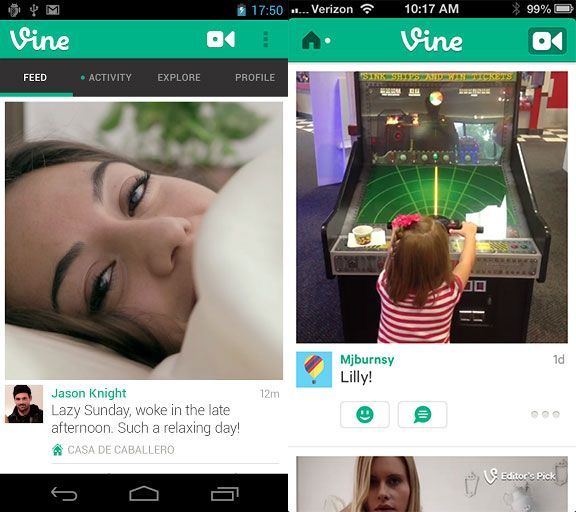
Twitter Releases Vine For Android Smartphones As It Tops 13M Users


VineAndroidBlog_0
Twitter has released Vine for Android, bringing the 6-second video sharing service to Google’s mobile OS for the first time. The Vine app is available for Android smartphones right now, and is afree download for anyone running Android 4.0 or higher.
The Vine app for Android arrives just about five months after it arrived on iPhone, when Twitter launched the app back in late January after acquiring the startup behind Vine. In that time, it has managed to amass an impressive 13 million users on iOS alone.
The version that arrives today for Android isn’t necessarily feature complete; the official Vine site says that it will be delivering a host of new features in future updates, including access to the front-facing camera, push notifications, the introduction of hashtag and mention features, and searching for both people and tags. These will arrive in “frequent” updates according to the company. Already, the Vine app for Android has a unique Android feature, as it supports zooming on both the Galaxy S4 and the HTC One.
Vine previously updated the iPhone app to add some of these features, including use of the front-facing camera, people mentions in posts and comments and improved people search in a big update that arrived at the end of April. Twitter’s Vine team appears to have taken the approach of launching a basic product and refining it on iOS, and now looks primed to do the same on Android.
vine-compThe tech world will be watching the next few weeks closely to see what effect Vine’s arrival on Android has on its user base, and there’s a pretty obvious opportunity for comparison ready at hand: Instagram. Instagram launched on Android back in April of 2012, after managing to build a user base 30 million strong on iOS. The photo-sharing app then added a million new users in just 12 hours thanks to Android users flooding the service.
Twitter had said that Vine would be coming to Android “soon” back at the end of April, though they didn’t offer a more specific date when it confirmed that impending release. Its launch today should certainly prompt a spike in new users, though just how many remains to be seen.

Samsung’s Shape-Shifting Ativ Q Isn’t Pretty, But Running Windows 8 And Android May Make It A Worthy Workhorse


Ativ Q
Samsung just pulled back the curtain on a new line of Ativ Windows notebooks, but perhaps the most interesting of the company’s new Ativs is a 13.3-inch convertible tablet it hopes will appeal those prepping to head back to school. The shape-shifting Ativ Q sports a tablet mode, a video-friendly formfactor with the screen held near vertical, and a more traditional notebook configuration that reveals its built-in QWERTY keyboard, but it’s got an even niftier trick up its sleeve.
While the Ativ Q boots into Windows 8 there’s also a dual-OS mode that allows the users to switch to stock Android 4.2.2, thereby allowing for Microsoft productivity staples such as Office to live in close proximity to the Google Play Store and the usual gamut of Android apps. It’s a cake-and-eat-it-too tablet. Or a tablet for someone who just can’t decide between Windows or Android.
The Ativ Q also supports the classic Windows desktop mode – and since the tablet includes Samsung’s S Pen stylus (which pulls out from a slot in its side) the tiny menus of classic Windows aren’t as fiddly as they would otherwise be to navigate on such a device.
Samsung said photos and files can be shared between the Windows and Android OS modes. Switching between the different OSes seemed fast during my brief hands on, although it’s relatively easy to accidentally revert to Windows. The Ativ Q is not a native Android device, being as it’s not booting directly to Android, but Samsung made a point of demoing a handful of Android games, including Angry Birds, running on the Ativ Q to show it is capable of handling such apps without a significant dip in performance.
The touchscreen display is QHD with a resolution of 3,200 x 1,800, which works out to a pixel density of about 275 PPI. The aspect ratio of the screen means the device feels quite long and narrow (not unlike plenty of other Windows convertibles). The entire device also feels very hefty – it’s not a tablet you want to hold in your hands for long — and it’s relatively thick, at 13.9mm wide. It is a serious bit of kit to lug about, but if you consider it as a laptop replacement rather than an iPad competitor then that’s perhaps to be expected. It’s certainly not the world’s most elegant slice of portable computing but Samsung is obviously hoping its flexibility is what will make it stand out.
Pulling up on the side of the screen when the device is in tablet mode lifts it out on a built-in hinged stand so it can be angled in a variety of ways, including a so-called “floating” mode suitable for presentations when a standing speaker needs to look down at the screen. The display can also be angled steeply up, with the keyboard entirely out of sight, to view videos. And it can be moved into a typing mode where the display is tucked behind the built-in keyboard.
This keyboard felt unpleasantly plasticky to my fingertips but it was relatively roomy, despite taking up less than half the width of the device. There’s no space for a trackpad but Samsung has added in an optical nav key in the centre of the keyboard if you prefer not to use the touchscreen, plus three physical selection keys at the edge of the keyboard to act as mouse keys.
Samsung has sited the device’s CPU and components inside the flexible stand portion of the device, rather than inside the screen or under the keyboard. It said it wanted to keep the hot parts away from the bits the user touches. Whether that’s a huge advantage remains to be seen, but it does mean the screen is thinner than it might have been otherwise, so probably a little easier to move around.
The screen has a Windows touch-key on the front which returns the user to the Windows 8 homescreen, There’s a tile on that interface for switching to the Android OS (and another for Windows Classic). When using the device in the Android scenario, there are additional nav keys along the bottom of the screen for switching back to Windows. The device being demoed during my hands on was running stock Android 4.2.2, rather than having any TouchWiz overlay.
Samsung said pricing for the Ativ Q will be confirmed later, and the price tag is likely going to be the deciding factor on whether this hybrid beast flies. It’s not what you’d call stylish or elegant, and its weight puts its portability in doubt, but it has the potential to be a bit of a workhorse -– with both Windows and Android, and tablet and QWERTY functionality on tap.

Line Expands Its Mobile Messaging Empire On Android With Third-Party App Downloads Incentivised By Line Coin


Line
The new breed of mobile messaging apps — Japan’s Line and China’s WeChat, to name two — are already siphoning off social energy by adding features traditionally associated with full-fat social networking such as in-app walls where their users can post status updates and photos. Line has also been pushing to become an entertainment hub in its own right, by adding richer content such as apps that extend its brand into areas like gaming. Today, it’s pushing its Android app ecosystem even further by adding an incentivised third party app discovery feature.
The new feature is called Line Free Coin, and is aimed at allowing Line to promote third party apps to its 170 million+ user-base — with downloads incentivised by virtual currency which users get when they install one of these apps. The virtual currency can then be used within Line’s ecosystem to pay for other goods, like its paid for stickers (“stamps”), thereby keeping them even more engaged within its ecosystem.
Here’s how Line describes the workings of the new feature:
Users will be introduced to sponsored apps carefully selected by LINE, and given “LINE Coin” virtual currency upon install. Using “LINE Coin”, users are able to exchange the virtual currency for paid stamps.
Line is partnering with Japanese ad network startup Metaps, which raised an $11 million Series B back in March, for the initiative. Metaps provides an SDK to Android developers so they can incorporate offers into their apps designed to increase engagement and improve app monetisation. Today the pair said they will become “global sales partners”, with Metaps providing the apps that will be listed on Line’s platform as part of the Line Free Coin push.
It’s unlikely this feature will be coming to Line’s iOS app. Last month Line pulled a feature from that app that had allowed users to gift paid-stickers to other users by purchasing virtual currency to pay for the stickers. The virtual currency component had evidently fallen foul of Apple’s in-app payment rules which require transactions to be conducted through its store, allowing it to take a cut.
On Android, of course, there’s no barrier to Line expanding its empire with virtual currency incentivised downloads — as it is now doing.

Turning the page with a new Google Play Books app for Android

Google Play Books enables you to read more than 4 million books on the go, and it's available in the U.S., Canada, Australia, Germany, Spain, Italy, France, Korea and Japan. Today we’re bringing new features to the Books app to help you better explore your books and understand what you’re reading.

Places and dictionary 
School’s now in full swing and students are picking up the classics. Whether you're diving into Moby Dick or trying your hand at some Tolstoy, we want to make your reading experience as enjoyable and rewarding as possible. Starting today, when you come across an unfamiliar geographic location—a faraway city or distant mountain range—you can tap on the location to learn more about it. You’ll see an info card with a Google Map and the option to get more information by searching on Google or Wikipedia.

Explore locations using info cards in Turn Right at Machu Picchu: Rediscovering the Lost City One Step at a Time

Similarly when you come across an unfamiliar word (say, abligurition or jentacular), just tap it for a quick definition.

Translation
For those adventurous readers making their way through books in non-native languages, you can now easily translate words or phrases to and from a number of languages. Just select the text or word and use the button on the top action bar to indicate which language you’d like translate into.

Highlighting and notes
If you happen to page through any of the books on my shelf, you’ll likely find highlighted passages and illegibly scrawled notes in the margins. Starting today, our app lets you highlight text and easily take notes. And because all your books live in the cloud, highlights and notes sync on your tablet, phone and the web.


You will also notice a new sepia reading theme (in addition to the current day and night themes), 2D sliding page turn animation, and lots of stability improvements. Finally, you can now read Japanese books in a vertical, right-to-left layout—and flip pages from right to left.

We hope these features make reading more enjoyable—and productive.

Thursday, 20 June 2013

Samsung's Ativ Q is a Windows laptop and an Android tablet in one insanely high-res package

Samsung Ativ QSamsung's famous for launching every type of device under the sun, but this time it's crammed them all into a single package. The company's just announced the Ativ Q, a dual-booting device that runs both Windows 8 and Android 4.2.2 inside a 13.3-inch convertible laptop package. The most impressive parts of the hardware are the insanely high-res 3200 x 1800 screen — the first use of the new display Samsung announced in May — and the flexible hinge that allows the Q to work in tablet mode, laptop mode, stand mode, and a sort of floating mode. From a hardware standpoint, it's remarkably similar to the Acer Aspire R7, though at .55 inches and 2.84 pounds it's a much more manageable device.
The Q is powered by an Intel Core i5 Haswell processor. Samsung says it'll get up to 9 hours of battery life, which would be quite the achievement for such a high-res device. But the real selling point is the dual-booting, and particularly the Side Sync software that lets you share data between the two operating systems, and even pin Android apps to your Start screen. It also lets you use your computer to back up your Samsung Android phone, and even use your PC keyboard to type on your phone. To hear Samsung tell it, the Ativ Q is basically a Windows computer with the Play Store — that's a pretty impressive proposition. And, of course, there's an S Pen.
Nt980q3gi_014_stand-left-angle_blue
Samsung also announced the Ativ Tab 3, a super-thin 10.1-inch tablet running Windows 8. It's all part of the Ativ family, which Samsung's made a big deal about — bringing laptops, tablets, and crazy convertibles all under the same roof. It looks a lot like the Galaxy Tab 3, a fact Samsung acknowledged during its press conference, but it's very much a full Windows device — "not the RT version," our emcee said with considerable disdain for Microsoft's low-powered OS. It's remarkably small for a full Windows device — it's 8.2mm thick, and weighs only 1.2 pounds. The Tab 3 comes with Office built in, and there's an S Pen here as well. Unfortunately it only has a 1366 x 768 screen, but Samsung promises up to eight hours of battery life.
As these are global launches, there's no word on when the new Ativs will come to the US or how much they'll cost. Samsung's tablet strategy has always been to be different, or at least be extreme. By launching the thinnest Windows 8 tablet, and a type of Windows tablet we've never seen before, the new Ativ models certainly fit the bill. And is it possible that Samsung just used Google to solve Windows' app problem?
300tzci_02_front_white