Barnes & Noble executives confirmed during the company’s fiscal year-ending earnings conference call that Nook sales are on the decline. To turn this segment around, the bookseller is ready to rethink its strategy for the eReader device.
Executives confirmed that sales of the tablet declined 34% in the fourth quarter, recording a $475 million EBITDA loss for fiscal year 2013. This figure was much higher than previous expected and is being interpreted as a sign that Barnes & Noble needs to change its tablet strategy.
Rather than go it alone, Barnes & Noble said it may partner with another hardware manufacturer to help make future tablet devices. The device would likely carry the brand name of the manufacturer as well as Barnes & Noble. This hardware partner was not identified during the company’s earning conference call, but Barnes & Noble CEO William Lynch did say that additional information would be released in the next few months.
Chalk up another point for the growth of apps coming out of Israel that are focused on consumers, but draw on the country’s better-known heritage for producing big data and enterprise startups. Wibbitz, a platform that draws on natural language technology, artificial intelligence and some clever algorithms to automatically translate texts into videos, is today launching a consumer-focused app.
The startup, whose lead backer is Horizons Ventures — the same VC that backed Google-acquired Waze, as well as two other services built around using natural language processing to make mobile life easier, Yahoo-acquired Summly and Siri — says that this is the latest step for taking its technology mainstream. Last year, the company picked up a Series A round of $2.3 million from Horizons, Initial Capital and lool Ventures and launched as a web-based service aimed mainly at enterprises, with some 50,000 sites taking up the service and generating close to 20 million video views each month.
If you go back to that news from a year ago, you will see how the app used to look, and it provides a useful marker show just how far it’s come along, in its first major update since that funding was announced.
Today, as you can see in the video below, there are significantly more dynamic video clips, info graphics and an overall smoother look to the product. Zohar Dayan, the CEO and co-founder of the company, says that Wibbitz has been working on the product you see today for over two years. “A lot of core technology and machine learning created by some very talented people went into this,” he says.
And the mobile app is just the beginning: “Right now we’re focusing on mobile, where reading text is difficult on a small screen. We see the most potential and highest need there,” he says. But he says that Wibbitz “also sees pain in smart TVs as well.” As more web content makes its way to bigger screens, he says, it can be just as difficult to read that as it is on small screens: “Reading text articles on TVs is impossible,” he says.
Launching a consumer app does not mean that Wibbitz is abandoning its B2B prospects, either. In a “stage two” in a few months time, Dayan says that it will be releasing the technology as an embedded service on third-party apps. One of the first that will use this is the Telegraph newspaper in the UK.
It is also in the process of raising another round of financing to keep moving ahead with its bigger plans to move away from text in places where it may be too challenging to read.
Barnes & Noble executives confirmed during the company’s fiscal year-ending earnings conference call that Nook sales are on the decline. To turn this segment around, the bookseller is ready to rethink its strategy for the eReader device.
Executives confirmed that sales of the tablet declined 34% in the fourth quarter, recording a $475 million EBITDA loss for fiscal year 2013. This figure was much higher than previous expected and is being interpreted as a sign that Barnes & Noble needs to change its tablet strategy.
Rather than go it alone, Barnes & Noble said it may partner with another hardware manufacturer to help make future tablet devices. The device would likely carry the brand name of the manufacturer as well as Barnes & Noble. This hardware partner was not identified during the company’s earning conference call, but Barnes & Noble CEO William Lynch did say that additional information would be released in the next few months.
According to new market share numbers from IDC, the International Data Corporation, Microsoft’s Windows Phone operating system is now in third place worldwide. It snatches the position previously held by BlackBerry which is now in fourth place; or in other words, the land of mediocrity.
This past quarter, IDC reports that Windows Phone accounted for 3.2 percent of worldwide phone shipments. BlackBerry accounted for 2.9 percent. That’s pretty sad for a company that practically dominated the industry not too many years ago. Windows Phone growth is slow, but hey, at least it’s growth. In fact, it’s better than what IDC predicted. Behind BlackBerry is Linux with 1 percent market share and Symbian with 0.6 percent.
Meanwhile Android and iOS continue to run the world. Combined, they add up to 92.3 percent of the market share. Android, of course, has a wide lead internationally, claiming 75 percent of all smartphones sold last quarter, leaving iOS with the remainder of 17.3 percent.
Symbian actually saw the greatest decline percentage-wise. In the first quarter of 2012 (the year-ago quarter) it held at 6.8 percent share. Technically, Windows Phone actually saw the most growth by percentage, because it grew 133 percent. However that’s only moving from 2 percent to 3.2 percent. The biggest overall leap made was by Android — from 59.1 percent to 75 percent. Though iOS shipment volume increased, market share decreased from 23 percent to 17.3 percent.
Microsoft has been working on improving its Bing voice recognition in Windows Phone recently. We saw some early advancements debut in aleaked video earlier this year,but the company now appears to be ready to launch some of those changes this week. The processing part of the voice recognition in Windows Phone,powered by Bing, has been improved for searches and composing text messages. Microsoft claims the tweaks mean results return twice as fast and the accuracy of picking up words has been increased by 15 percent.
The improvements all come thanks to some Microsoft Research work known as Deep Neural Networks (DNNs). The software giant claims the system can detect patterns in a similar way that biological systems analyze huge sets of data and recognize similar patterns. While Microsoft previously revealed a "streaming mode" for Windows Phone voice recognition in private, that lets users search while they speak, the updated improvements simply improve the speed and accuracy for now.
A massive anti-government protest in Istanbul, prompted after days of unrest were sparked by plans to redevelop one of the last remaining central public parks, appears to have led to a throttling of social media both in the city and across Turkey. TechCrunch has independently verified via a number of sources that both Facebook and Twitter have been almost impossible to access from inside Istanbul, and other parts of Turkey. There are also anecdotal reports of authorities switching off access in a localised manner around Taksim Square where thousands of people are demonstrating.
There have been violent scenes in Istanbul, with police firing tear gas and water cannons at people demonstrating against the erection of a shopping centre in a space widely considered to be a protected civic area. The demonstration has escalated into an anti-government and anti-corruption protest against an administration that has been in power since 2002.
Our sources – drawn from the tech community – say that around 99 percent of Facebook “doesn’t load” when accessed from Istanbul.
“They throttled the bandwith to the bare minimum so that officially it’s not blocked, but it’s not loading any more… it looks like the government is reducing the speed using TTNET which is the ISP they control,” said one, who declined to be named for fear of reprisal.
Another source told us: “3G is blocked.”
Another well-placed source at a tech accelerator told us: “We had problems in connecting internet today – mostly due to people trying to access through 3G network. However around 4pm local time access to Twitter and Facebook has been blocked on local ISP (two major ones TTNet and Superonline which among two have over 90% of the land line internet access). I connected through Acevpn and saw that the problem is not my home line but TTNet blocking the access to Twitter and Facebook.”
This source said this happened at a time where the tension was at its peak when protesters were trying to get into the target “Gezi Park” area. “After 30 minutes (approximately) the police withdrew from the area and Twitter Facebook access came back,” he told us.
A spokesperson from Facebook said the company declined to specifically comment on events in Turkey; however they issued the following statement: “The Internet provides people around the world with the power to connect, to learn, and to share. It is essential to communication and to commerce, and limiting Internet access for millions of people is a matter of concern for the global community.”
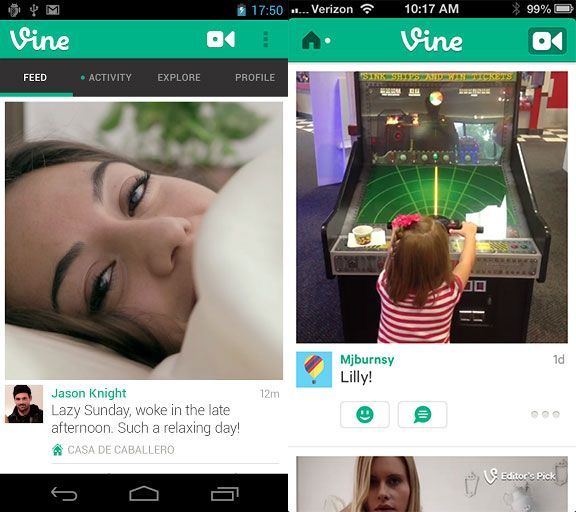
Twitter has released Vine for Android, bringing the 6-second video sharing service to Google’s mobile OS for the first time. The Vine app is available for Android smartphones right now, and is afree download for anyone running Android 4.0 or higher.
The Vine app for Android arrives just about five months after it arrived on iPhone, when Twitter launched the app back in late January after acquiring the startup behind Vine. In that time, it has managed to amass an impressive 13 million users on iOS alone.
The version that arrives today for Android isn’t necessarily feature complete; the official Vine site says that it will be delivering a host of new features in future updates, including access to the front-facing camera, push notifications, the introduction of hashtag and mention features, and searching for both people and tags. These will arrive in “frequent” updates according to the company. Already, the Vine app for Android has a unique Android feature, as it supports zooming on both the Galaxy S4 and the HTC One.
Vine previously updated the iPhone app to add some of these features, including use of the front-facing camera, people mentions in posts and comments and improved people search in a big update that arrived at the end of April. Twitter’s Vine team appears to have taken the approach of launching a basic product and refining it on iOS, and now looks primed to do the same on Android.
The tech world will be watching the next few weeks closely to see what effect Vine’s arrival on Android has on its user base, and there’s a pretty obvious opportunity for comparison ready at hand: Instagram. Instagram launched on Android back in April of 2012, after managing to build a user base 30 million strong on iOS. The photo-sharing app then added a million new users in just 12 hours thanks to Android users flooding the service.
Twitter had said that Vine would be coming to Android “soon” back at the end of April, though they didn’t offer a more specific date when it confirmed that impending release. Its launch today should certainly prompt a spike in new users, though just how many remains to be seen.
Dekko, a San Francisco-based startup that just closed extra funding to build a platform for augmented reality apps, just brought its first title to market with a racing game that has players drive virtual cars across tabletops.
OK, so augmented reality, which overlays virtual items or information over the real world through a phone or tablet’s viewfinder, hasn’t really come into its own yet. There have been plenty of companies like Layar, which built one of the very early augmented reality browsers for the iPhone, which have been around for a few years.
That’s partially because the user experience is still a bit unwieldy with people having to take their phones or iPads out and pan their built-in cameras around. But it’s possible that Google Glass could change all of this.
Dekko, which recently took an additional $1.3 million in funding, is betting that augmented reality’s moment could be around the corner. Other startups are making this bet as well; another companyDaqri just picked up $15 million in a Series A round for augmented reality as well.
“We wanted to solve many of the basic user problems with augmented reality. We had a compulsion to at least show something that’s real and fun,” said co-founder and CEO Matt Miesnieks. “We wanted to build an experience that is kind of magical.”
The game, which you can demo below, has players hold up their iPads over a table. On the screen, you can see cars racing across a virtual track. It can turn any kind of flat surface into racetrack that’s visible on the iPad. The app is also multiplayer, allowing between one and four people to race each other, do stunts and crash into each other’s cars. The multiplayer mode can show a single, real-time shared view.
Tabletop Speed Trailer from Dekko on Vimeo.
To me, it sounds like a proof of concept that demonstrates Dekko’s platform, which was built by the startup’s in-house team of computer vision experts. Eventually, they’ll bring their platform to wearables like Google Glass.
“One thing we know about Glass is that our tech will work on it,” Miesnieks said.
Dekko’s backers include Echo Ventures, Bessemer Venture Partners, Venture 51, Blumberg Capital, Launch Capital, Thomvest, Eniac Ventures, and Zig Capital, as well as angels like Howard Lindzon, Erik Moore, Dan Conway, and Raymond Tonsing.