Today, there’s a long list of apps and services that sit at the intersection of fitness and mobile technology and leverage everything from social dynamics and behavioral economics to Quanitifed Self-inspired tracking to motivate us to be more active and drop a few pounds. There’s Lift, Nike+, Basis, RunKeeper, Runtastic, Fitocracy, Endomondo and MyFitnessPal — the list goes on and on.
Rather than simply adding another me-too product to an already-crowded space, two former Microsoft product managers launched Cody earlier this year to offer an experience they think has been missing from the world of mobile fitness. Co-founders Pejman Pour-Moezzi and Paul Javid tell us that the majority of fitness apps today tend to cater to hardcore fitness enthusiasts, who get a lot of mileage out of wearable gadgets and obsessive data-tracking.
By nature, many of these products revolve around activities where GPS and accelerometer-based tracking and metrics really come in handy, like running and cycling. Of course, not everyone wants to track every second of their day or exercise routine, is wearing a Fuel Band (or some alternative thereof) or is an avid runner.
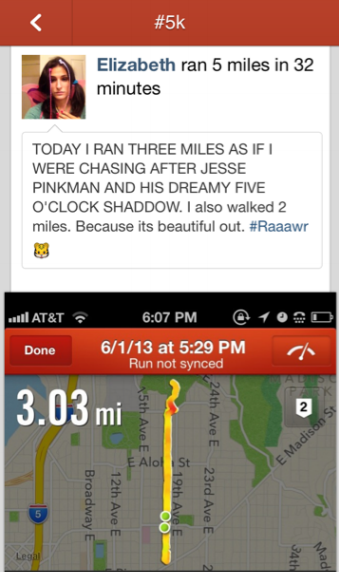
Rather than targeting hardcore Quantified Selfers or focusing on running, Cody is going after casual fitness enthusiasts by emphasizing sharing rather than tracking and by building an experience that’s more reminiscent of Instagram and Vine than RunKeeper and Nike+. On Cody, users can add photos, videos, tag their location and leave status updates — actions aimed at making it easy to share the story of their daily fitness routines, rather than the metrics.
Users can log and share workouts across a range of categories, like Crossfit, Yoga, Barre, weightlifting, walking, running and cycling, and 70 percent of the workouts logged fall outside of running and cycling, the co-founders tell us.

“One of the things we want to tap into is the group-fitness movement,” Javid says, “which happens to be one of the fastest growing segment in fitness.” The goal instead is to create a mobile experience that people don’t just open when they have something to track. Since launch, Cody has seen a lot of activity around group-fitness categories, like CrossFit, Yoga and Barre, but 85 percent of user sessions on Cody don’t even include a workout, he explains.
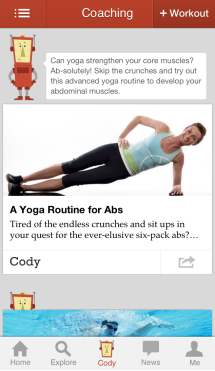
By allowing users to describe their workout, follow their friends and top users — along with commenting on their status updates — and by recommending articles and offering tips, Cody is building a social fitness experience that centers around consumption. The app also incorporates some familiar tracking features, allowing users to review past performance and view personal highlights in graphical layouts and swipe through a calendar of each of your activities, while filling out their personal profile that is shown to others in the network.
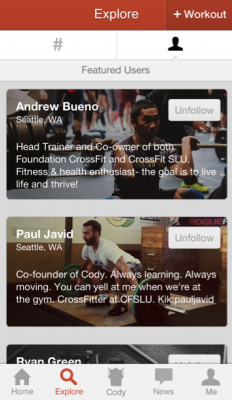
While there’s value in being able to browse through a shared workout feed to check in on what your friends are doing, a key part of creating a social fitness experience and a “fitness graph” like this is discovery. And up until now, that’s largely been missing from Cody. But today, Cody is adding a new feature called “Explore,” which makes it easier to discover people and workouts, and browse through other Crossfitters, yogis and weightlifters with one tap.
Explore intends to make it easier to find and follow people by grouping them into categories, so that you can search and discover workout pals by activity, Featured Users or Featured hashtags, like “#5K,” for example. Like Edomondo and other apps, Cody has also set out to add value to its fitness network by acting as a virtual coach.

After users download the app, they’re asked to identify their goals, whether that be running 10 miles or reducing a little bit of stress, which Cody uses to surface content and tips relevant to those goals. Now, with its Explore feature, Cody is adding another piece of the puzzle in pursuit of being able to more accurately recommend friends, workouts, information and venues based on their activity and interests.
It’s a similar path to the one followed by Twitter and Foursquare — the more data it has on you, your friends, your favorite workouts and workout spots, the better it can help you find people you’ll enjoy meeting, following or working out with, and content that better helps you meet your goals.
By providing a familiar Instagram-like feed and Twitter-inspired Hashtags in a clean, simple design, Cody is reducing some of the friction less hardcore fitness enthusiasts might experience at the thought of downloading another fitness app. If Cody can successfully strike content deals with top fitness publications to offer quality fitness content and offer support for various fitness-tracking health gadgets, there are plenty of ways for Cody to incentivize potential customers.

Furthermore, Cody hasn’t yet settled on a business model, but by, say, offering top yoga instructors the ability to post five-minute instructional videos in an activity feed that users can access for a fee or by allowing local gyms to create profiles and target in-stream ads (a la Twitter) at local exercisers, it has some potentially cool opportunities to begin monetizing, while adding value for local businesses and instructors.
However, with Fitocracy already offering a popular, fitness-dedicated social network and with the bevy of fitness apps out there that have a running head-start, Cody has its work cut out. Apps like Runkeeper already have sizable user bases and data pools to work with, and it wouldn’t be a stretch to imagine them putting that to use to enhance the discovery experience at some point down the road.
Cody is off to a great start, and while the road ahead is a steep one, by targeting more casual exercisers, focusing on adding value to the social, mobile fitness experience and catering to a wider range of activities, it may be able to find its niche in a crowded market.