Showing posts with label Users. Show all posts

Monday, 24 June 2013

Nokia Ad Makes iPhone Users Zombies

nokia-lumia-925-commercial
Nokia capitalizes on the zombie craze in its latest ad for the Lumia 925, targeting the iPhone 5 and its camera. You can watch the clever ad below.
It seems like the diss ads are piling up lately, making the mobile phone market look like the United States during election season. Microsoft has had some gems lately, and the Galaxy S series ads have long taken cheap shots at Apple devices’ shortcomings. This latest ad from Nokia shows a group of pale-faced, red-eyed zombies stalking a man on the night-time streets of a city.
The joke is on the iPhone camera, as the zombiedom is passed through the use of its flash. The zombies are washed out, pale and red-eyed due to the use of the iPhone 5′s back facing LED flash, much like subjects in flash photos often end up.
The Lumia 925 has excellent l0w light capabilities, unlike pretty much any other smart phone camera currently available, its CCD can take clear night-time images without the need for flash.
So, surprisingly, the joke isn’t that iPhone users are zombie like followers (a common theme in Samsung ads), it’s about the camera! Apple generally tends to take the high road with this type of advertising, and doesn’t bite back. But maybe an Apple ad focusing on the plusses of the iPhone camera will be coming soon?

WhatsApp now has more than 250 million monthly users

whatsapp (stock 1020)
There's been little doubt that WhatsApp is one of the most-used cross-platform messenger apps out there, but the company has been rather coy about revealing specific user numbers. Back in April, the WhatsApp CEO did claim his service had a bigger userbase than Twitter's 200 million users and processed 18 billion messages per day (more than Facebook), but now the company's giving more concrete details. According toThe Wall Street JournalWhatsApp has a userbase of over 250 million active users every month, exceeding the 200 million users that Twitter cited on its seventh birthday. While there's no doubt that WhatsApp is one of the most dominant players in the smartphone messaging space, it's an increasingly crowded one — but there's no doubt that it's keeping up with major players like Facebook and Skype, which is a pretty notable achievement for an app that's only four years old
.

Saturday, 22 June 2013

Twitter Releases Vine For Android Smartphones As It Tops 13M Users


VineAndroidBlog_0
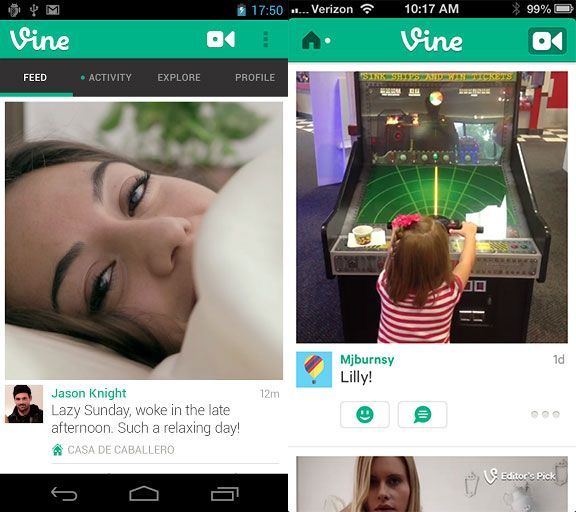
Twitter has released Vine for Android, bringing the 6-second video sharing service to Google’s mobile OS for the first time. The Vine app is available for Android smartphones right now, and is afree download for anyone running Android 4.0 or higher.
The Vine app for Android arrives just about five months after it arrived on iPhone, when Twitter launched the app back in late January after acquiring the startup behind Vine. In that time, it has managed to amass an impressive 13 million users on iOS alone.
The version that arrives today for Android isn’t necessarily feature complete; the official Vine site says that it will be delivering a host of new features in future updates, including access to the front-facing camera, push notifications, the introduction of hashtag and mention features, and searching for both people and tags. These will arrive in “frequent” updates according to the company. Already, the Vine app for Android has a unique Android feature, as it supports zooming on both the Galaxy S4 and the HTC One.
Vine previously updated the iPhone app to add some of these features, including use of the front-facing camera, people mentions in posts and comments and improved people search in a big update that arrived at the end of April. Twitter’s Vine team appears to have taken the approach of launching a basic product and refining it on iOS, and now looks primed to do the same on Android.
vine-compThe tech world will be watching the next few weeks closely to see what effect Vine’s arrival on Android has on its user base, and there’s a pretty obvious opportunity for comparison ready at hand: Instagram. Instagram launched on Android back in April of 2012, after managing to build a user base 30 million strong on iOS. The photo-sharing app then added a million new users in just 12 hours thanks to Android users flooding the service.
Twitter had said that Vine would be coming to Android “soon” back at the end of April, though they didn’t offer a more specific date when it confirmed that impending release. Its launch today should certainly prompt a spike in new users, though just how many remains to be seen.

Thursday, 20 June 2013

Google opts out of FISA disclosure deal made by Facebook and Microsoft, calls it 'a step back for users;' Twitter agrees

google now campus 1
Google is unsatisfied with the deal that Microsoft and Facebook have made with the US government with regard to publishing how many requests for user information they both receive. Facebook and Microsoft released reports tonight detailing how many requests they got from US government agencies in the second half of 2012 — including FISA requests. The deal, however, comes with strings that Google apparently doesn't want to be tied to.
There were restrictions put on Facebook and Microsoft's disclosures that make them fairly useless if you're interested in determining how many FISA requests have come in. As Microsoft says, it can only include the number of FISA requests it receives so long as it is "aggregated with law enforcement requests from all other U.S. local, state and federal law enforcement agencies; [and] only if the totals are presented in bands of 1,000." The same rules appear to apply to Facebook, as well.
Those restrictions mean that you wouldn't be able to tell how many of the 8-9,000 requests each company received were from local law enforcement or from the NSA. So Google is having none of it. Here's what a Google spokesperson said to The Verge(emphasis ours):
We have always believed that it's important to differentiate between different types of government requests. We already publish criminal requests separately from National Security Letters. Lumping the two categories together would be a step back for users. Our request to the government is clear: to be able to publish aggregate numbers of national security requests, including FISA disclosures, separately.
To be fair, both Microsoft and Facebook have also been pushing hard for more transparency and more freedom to disclose what types and how many requests they receive. All three companies have come under heavy fire from users after initial reports about PRISM suggested that the US government had "direct access" to their servers, a charge each company has consistently (and vehemently) denied.
Even so, the increased scrutiny on the NSA and its data mining activities — however they are carried out — has tech companies scrambling to ensure that the public directs its ire at the government and not at them. Despite each company's different short term tactic when it comes to disclosing numbers, their long-term strategy on transparency appears to be the same: more of it.
Update: Benjamin Lee, Legal Director at Twitter, has just signaled his company's agreement with Google's stance. He did it, appropriately enough, via a tweet:

Wednesday, 19 June 2013

Facebook Now Lets US Users Pay $7 To Promote Posts To The News Feeds Of More Friends


Facebook Promoted Posts
Facebook is expanding to the U.S. the controversial Promoted Posts feature that lets users pay to get their posts more visibility in the news feed. It will cost $7 per post and Facebook hopes it will be used for garage sales, parties, wedding photos and other important announcements.
Promoted Posts has already been rolled out to 20 other countries and is available to people with fewer than 5,000 total friends and subscribers. Promoted Posts could help surface important announcements and earn Facebook money. However, I worry that Promoted Posts could change the atmosphere of Facebookfrom one where the most beloved content gets seen most to one where the rich can dominate the news feed.
Facebook first began testing the product, then called Highlight, in May in New Zealand. It’s still testing price points for the U.S. so it could go up or down from $7, and cost varies across international markets to sync with what’s appropriate for local economies.

HOW PROMOTED POSTS GET THE WORD OUT

After you publish a post, a Promote button will let you pay to bump up its rank in the news feed — making it appear both higher in the feed, and to a larger portion of your friends. Unpromoted posts are typically only seen by 12-16 percent of your friends.
After you Promote a post, it will be marked “Sponsored,” and you can check to see how many more people saw it because you paid. For example, you’d see “So far your post has had 3.8x as many views because you promoted it.”

IS PAY-TO-PLAY OKAY?

Facebook is becoming a critical one-to-many communication medium for people. Often we’re just sharing fun things that we don’t desperately need eyeballs on, but other times a better news feed position could really help. If I’m trying to sell all my possessions before moving to Thailand, Promoted Posts could be a cost-effective way of making sure more friends know about my garage sale. Raising money for charity or looking for bone marrow donors are some other clearly positive applications.
But as with anything on a sandbox service like Facebook, the success and impact of Promoted Posts will depend on how people use it. A friend with a trust fund could promote every post he publishes just because he has the money. In that way, the feature could distort the news feed’s meritocracy, where posts that get lots of likes and comments are shown to more people.
It could turn into a big money maker, though. Since the $7 is essentially all profit, Facebook could nearly double its revenue per user if it could get each US user to promote just one post a year.
If Facebook isn’t careful, Promoted Posts could offend and marginalize financially-strapped users. If it makes sure to minimize overuse, though, it could give people a powerful way to identify what their most important content is: putting their money where their mouth is.

Tuesday, 18 June 2013

Mobile Games Not As Popular With Millennials, Compared With Other Smartphone Users


Screen Shot 2013-06-09 at 9.29.53 AM
Dekko, a San Francisco-based startup that just closed extra funding to build a platform for augmented reality apps, just brought its first title to market with a racing game that has players drive virtual cars across tabletops.
OK, so augmented reality, which overlays virtual items or information over the real world through a phone or tablet’s viewfinder, hasn’t really come into its own yet. There have been plenty of companies like Layar, which built one of the very early augmented reality browsers for the iPhone, which have been around for a few years.
That’s partially because the user experience is still a bit unwieldy with people having to take their phones or iPads out and pan their built-in cameras around. But it’s possible that Google Glass could change all of this.
Dekko, which recently took an additional $1.3 million in funding, is betting that augmented reality’s moment could be around the corner. Other startups are making this bet as well; another companyDaqri just picked up $15 million in a Series A round for augmented reality as well.
“We wanted to solve many of the basic user problems with augmented reality. We had a compulsion to at least show something that’s real and fun,” said co-founder and CEO Matt Miesnieks. “We wanted to build an experience that is kind of magical.”
The game, which you can demo below, has players hold up their iPads over a table. On the screen, you can see cars racing across a virtual track. It can turn any kind of flat surface into racetrack that’s visible on the iPad. The app is also multiplayer, allowing between one and four people to race each other, do stunts and crash into each other’s cars. The multiplayer mode can show a single, real-time shared view.
Tabletop Speed Trailer from Dekko on Vimeo.
To me, it sounds like a proof of concept that demonstrates Dekko’s platform, which was built by the startup’s in-house team of computer vision experts. Eventually, they’ll bring their platform to wearables like Google Glass.
“One thing we know about Glass is that our tech will work on it,” Miesnieks said.
Dekko’s backers include Echo Ventures, Bessemer Venture Partners, Venture 51, Blumberg Capital, Launch Capital, Thomvest, Eniac Ventures, and Zig Capital, as well as angels like Howard Lindzon, Erik Moore, Dan Conway, and Raymond Tonsing.