Showing posts with label at. Show all posts

Friday, 28 June 2013

New Windows 8 Devices at Samsung London Event: the ATIV Q is Awesome!

Samsung just announced 3 new devices that will join the ATIV family. The ATIV line from Samsung are the Windows based devices and at the reveal in London Samsung showed us two new laptops, A hybrid tablet running both Windows 8 and Android, a Windows 8 tablet and finally an all in one computer.
ATIV One S Style
The ATIV One 5, Samsung's All in One Computer / © samsungmobile.com
Samsung ended up showing us 9 new devices at the London event today, some of which where Galaxy devices which you can read about here. There were a total of 4 Galaxy devices revealed at the event and a total of 5 Ativ devices.

ATIV Q

The first device to be shown to members of the audience was the Samsung Ativ Q. This device is a hybrid one running two operating systems in Windows 8 and Android 4.2.2. One really neat feature about this device is that it allows you to seamlessly switch between the Windows 8 OS and the Android Jelly Bean OS. The Ativ Q also has a screen resolution of 3200 x 1800 which is the highest screen resolution in the world at the moment. The device can be used as a normal tablet, as a laptop with a keyboard, and can be placed in a reading or viewing position. Files can be shared around the two operating systems and the battery life is also impressive at it comes in at about 9 hours.
ativ q 1

ATIV Tab 3

Samsung's Ativ tab 3 looks a lot like the Samsung Galaxy tab but this device is of course running Windows 8 and it is the world's thinnest Windows 8 tablet at well. The 10 inch tablet has a resolution of 1366 x 768 and has 64 GB of onboard storage. The storage is also expandable as the device comes with a Micro SD slot. Other features include an HDMI out port, and also a good 2 GB of RAM. This device along with the Ativ Q also includes a stylus which can be used for things like drawings etc.

ATIV Book 9 Plus

This is the flagship Windows 8 laptop from Samsung. This high end device has a wonderful design, comes in at a thickness of 13.6mm and weighs in at just over 1.3 kg's. The device has the same screen resolution as the Ativ Q at 3200 x 1800 and the same size display at 13.3 inches. Other specs include 256 GB SSD, a micro HDMI port and also 2 USB 3.0 ports. Gorilla Glass is the material protecting the screen which also boasts touchscreen functionality.

ATIV Book 9 LITE

This is the cheaper version of the Ativ book 9 range of laptops. It comes in with a lot of the things that the Ativ Book 9 has but at a more affordable price. The screen resolution is no longer the 3200 x 1800 qHD but a more humble 1366 x 768 which is a noticeable drop when you view the two side by side. On the outside though the two look very similar.

ATIV One 5 Style

This device is a desktop PC running Windows 8, with the same look and feel as the Galaxy family of devices. The machine boasts a quad core AMD A6 processor and 4 GB of RAM. As far as storage is concerned it goes all the way up to 1 TB which means you will probably not run out of storage space for all your files. Moving on to connectivity, you have 3 USB 3.0 ports, 2 USB 2.0 ports, Bluetooth 4.0 and HMDI in and out.
It seems as if Samsung is looking to replicate the success of its Galaxy line with these Windows devices. Tell us what you think of Samsung's latest efforts by leaving a comment below.

Wednesday, 26 June 2013

Samsung launches Galaxy NX, Ativ Q, and much more at Premiere 2013 event

Samsung Galaxy Ativ event
Samsung promised new Android and Windows devices at its June 20th event in London and it delivered. The Galaxy NX wedded Android with an interchangeable lens camera, the Ativ Q combined Android and Windows into a crazy convertible tablet form factor, and two new Ativ Book laptops brought Samsung's ultrabook line into the Haswell age.

Catch up on all of Samsung's announcements right here.

Peloton’s Android exercise bike with a 21.5-inch screen raising money at Kickstarter

Peloton's Android exercise bike with a 21.5-inch screen raising money at Kickstarter

We’ve seen a number of different Android devices, including phones, tablets, cameras, TVs and set-top boxes. Like that’s not enough, now we have an exercise bike relying on Google’s mobile platform raising cash and awareness at Kickstarter.
The Peloton Bike has top notch specs, including:
  • Frame: Carbon steel and aluminum monocoque construction
  • Resistance: Neodymium rare earth magnet resistance system
  • Drive: Poly V power transmission belt drive
  • Pedals: LOOK Delta compatible thermoplastic pedals
  • Seat: Sport series saddle with depressed ergonomic center channel
  • Crank arms: 170mm carbon steel
  • Bottom bracket: Precision steel 13/68mm
As for the brains part, there’s a 21.5-inch full HD touchscreen running Android 4.1. Inside that big-ass display, you have TI’s OMAP 4470 dual-core processor clocked at 1.5GHz, 1GB of RAM, wired (Ethernet) and wireless (Wi-Fi + Bluetooth) connectivity, stereo speakers, 1.3-megapixel camera, and all the software an exercise fan could need (with the ability to install even more apps).

Monday, 24 June 2013

Google Will Soon Start Selling Chromebooks At Walmart And Staples, Other Retailers Coming Soon

Features of ChromebooksGoogle sure isn’t giving up on its Chromebook initiative, even though it’s not clear that the company’s Chrome OS-based laptops are selling all that well. Today, Google announced that it’s expanding its brick-and-mortar retail efforts for Chromebooks through partnerships with Walmart and Staples.
Over 1,500 Staples will feature them starting this weekend and about 2,800 Walmart stores will carry Chromebooks later this summer. In total, Google says, this will triple the number of stores that carry its Chromebooks and bring the total number to 6,600 stores around the world.
Walmart, it seems, will only make the cheapest Chromebook — the $199 Acer Chromebook — available on its shelves, though. Staples will feature “a mix of Chromebooks from Acer, HP and Samsung” and will also make them available online. The more expensive Pixel, Google’s high-end Chromebook, won’t be available at any of these retailers, it seems.
The company also announced that select Office Depot, Office Max, Fry’s and Tiger Direct locations will begin selling Chromebooks in the “coming months.” Previously, only Amazon and Best Buy carried Google’s laptops.
hp-chromebook-right-facing

Expansion Outside Of The U.S.

Google is also expanding the availability of Chromebooks internationally. In the U.K., for example, 116 Tesco stores are now selling Chromebooks; in the Netherlands, Mediamarkt and Saturn will carry them and France’s FNAC stores will also get Chromebook displays. Google is also adding partners in Australia (JB Hi-Fi and Harvey Norman) and Sweden (Elgiganten).

Microsoft Uses Siri Again To Take Jabs At The iPad

ipadvsdell
Microsoft is at it again with its iPad-jabbing ads for Windows 8 tablets, using Siri as it’s weapon. This time around, the ad showcases Dell’s XPS 10 tablet against the world’s most popular tablet.
The ad is simple and to the point. Microsoft uses Apple’s Siri to make comments on the differences between the two tablets, all of which favor in the Windows 8 option. Clever.The features highlight the “zoom-out” function of the start screen, multiple windows, and expandable storage, with the kicker being the price point. For a limited time, the Dell XPS 10 is only $399 vs the $499 Apple iPad. Even still, we’d say that Apple’s significantly larger App Store should justify the premium, but features like expandable storage should definitely appeal to the customer.
With rather pitiful sales numbers for Window 8, Microsoft seems to take no issue pulling out all the stops with these type of ads. And we’re just going to go out on a limb here and say that the ads likely won’t have people rushing out to buy a Windows 8 tablet. Nonetheless, it’s cute to see the company trying.
Now if only Apple would start the I’m A Mac type of ads again.
Have a look at the ad below and tell us what you think. If we’ve learned anything from the ad, it’s not to pinch Siri.

Hipster Zombies -Shoot Pabst Cans at the Ironic Undead!

unnamed
Sharkbomb’s recently released mobile game might be the ultimate stress reliever. Hipster Zombies pits you against huge mobs of hipsters who constantly attack, new wave after new wave. You’ll defend your side of the screen from your arrogant attackers in a similar way to Plants Vs. Zombies. Oh, and they’re zombies too, so it’s OK to shoot them.
There are different hipster types such as obnoxious pipe guys, sunglasses and blazer jerks and headbanded neo ravers. Players strafe up and down the side of the screen using different ammunition, such as LPs, glasses and Pabst cans in their garbage cannon. It’s free to play but extras can be purchased with micro transactions. Hipster Zombies is available on iTunes and the Google Play Store
From the Play Store:
When hipsters turn themselves into zombies and haunt the living it’s time to fight back. Ironically.
Fight against legions of pretentious undead in this light-hearted arcade action game.
**********************************************
At night the hipsters leave their hiding holes, walking towards you looking for brains. Brains and vintage clothes. Now it’s your job to stop them from infecting and plundering your neighborhood. Granted, it’s not that bad a job if you ignore the lethal risks. After all you get to frag some zombies.
* Wield a variety of different ironic trash-weapons
* Collect coins to upgrade and add to your arsenal
* Defend different locales of your neighborhood against the hipster horde
* Freely move in 2 directions!
“It’s just like plants vs zombies without plants. Instead you have Instagram hipsters and direct control. So awesome!” – Frank Wiener, huge fan.

The Ascend P6 is Huawei's latest attempt at a flagship Android smartphone

Ascend p6Huawei is in London today launching its new smartphone, the Ascend P6. The first thing you'll notice about the P6 is it's incredibly thin — Hauwei says it's 6.18mm thick, which is far thinner than Apple's iPhone 5 or the Samsung Galaxy S4. Huawei also claims it's the "world's thinnest" smartphone, but as is often the case with such titles, that achievement is set to be eclipsed by another Chinese competitor soon. The Ascend P6 is pretty light: at 120g, it weighs 10g less than the Galaxy S4. Despite its small shell, Huawei has managed to squeeze in what are essentially the internals of the LG Nexus 4. There's a 4.7-inch 1280 x 720 LCD with in-cell touch, an unspecified 1.5GHz quad-core processor, 2GB of RAM, a 2000mAh battery, and 8GB of internal storage (expandable via a microSD card slot).
Compared to Huawei products we've seen in the past, the Ascend P6 is definitely a step up in quality. Available in black, white, or pink, it's constructed mostly from plastic and doesn't feel cheap, but it's not exactly premium either. The sides are made from aluminum and have an antenna notch that'll be familiar to anyone that's seen an iPhone in the past three years. One odd facet of the design is the corners, which are rounded much like most smartphones at the top, but at the bottom curve round to meet the back of the phone. It's an strange design decision — the two styles don't work particularly well together in my opinion. Another niggling aspect of the design are the device's power and volume controls: they're a little too shallow, and there's no comforting "click" when you press them. Apart from that, everything seems well put together, and the display is good enough — it looks almost identical to the Nexus 4's screen.
Dsc02161
THE CAMERA SOFTWARE HAS A 'BEAUTY LEVEL' SLIDER TO MAKE YOU MORE ATTRACTIVE
Huawei is making noise about the P6's photographic abilities. The rear-facing camera has a backside-illuminated 8-megapixel sensor and an f/2.0 lens. Huawei says the camera can shoot close up photos from as little as 4cm (about 1.5 inches) away. Its front-facing camera is also pretty special, on paper at least: it's a 5-megapixel unit, far higher than most smartphones. Huawei has equipped the front-facing camera with "Auto Face Enhancement," which comes with a "beauty level" slider that can apparently make you more attractive in your self portraits. When I tried it out, all it seemed to do was blur my face slightly and make my cheeks a little more red.
Beautylevel10
We took a few quick shots with the P6 and found the camera to be fairly capable. It definitely can't compete with Nokia's Lumia 920, and falls short of the iPhone 5 and HTC One, but from my brief time with it I could see myself using it regularly without too much issue. The same can't be said for Huawei's Android skin, unfortunately. Called the "Emotion UI," it's based on the latest version of Android, 4.2.2, but it's a pretty heavy skin that feels like an attempt to ape Samsung's love-it-or-hate-it interpretation of Google's OS.
Ascendiphone6
There are a few good ideas in the skin, though, not least of which are granular controls over notifications and data access. Much like iOS' centralized settings for Notification Center, you can stop any app from creating notifications, and you can also prevent apps from using your mobile data. Another thing the skin has over HTC's and Samsung's efforts is the inclusion of on-screen buttons, so at least there won't be any irritating on-screen menu prompts within apps.
Dsc02186
Huawei believes that its smartphone's quality, combined with a comparatively low price tag, will be enough to overcome its competitors' marketing budgets. The Ascend P6 isn't likely to ever make it to the US anytime soon as it doesn't have LTE connectivity built in — Huawei says an LTE version will come this fall. It's planning to launch the phone in the UK, mainland Europe, and Australia shortly, expanding to 100 countries by the end of the year. It'll be priced at €449 ($600) without a contract, which is quite a bit cheaper than most "flagship" products.

Saturday, 22 June 2013

An inside look at the world's largest solar-powered boat


via cdn1.sbnation.com

Catamarans are fairly odd-looking boats, but earlier this week a special breed was docked at the North Cove Marina in Lower Manhattan. Alongside the typical handful of South Florida-based yachts that pop up here during the summer was an angular, flat-topped catamaran with a glistening blue deck called the MS Tûranor PlanetSolar. There's a reason why this boat stands out: last year it became the first ship to circumnavigate the globe on solar power alone. The 89,000 kg (nearly 100 ton) ship needs a massive solar array to capture enough energy to push itself through the ocean. An impressive 512 square meters (roughly 5,500 square feet) of photovoltaic cells, to be exact, charge the 8.5 tons of lithium-ion batteries that are stored in the ship's two hulls.
The Tûranor PlanetSolar (tûranor means "power of the sun" in Elvish) is taking a break in New York from its current mission: a science expedition from Miami to Norway led by a University of Geneva-based research team. The climatologists, biologists, and physicists aboard the PlanetSolar are taking measurements of the Gulf Stream to better understand the relationship between the ocean and the atmosphere in an effort to gain new insight about climate change. In particular, they're studying and measuring currents, airborne particles called aerosols that reflect infrared heat and solar radiation, and the myriad natural phenomena that allow the Gulf Stream to function. Since the PlanetSolar is seaworthy and is emission-free, it allows the team to ensure that measurements aren't skewed by exhaust.
During the New York stopover press was invited aboard the PlanetSolar for a view of this boat that functions without any carbon emissions. The vessel might not be the most practical — it's big, it's slow, and it needs to avoid clouds — but it's a bold demonstration of how renewable resources might power ships of the future.
Hint: Use the 's' and 'd' keys to navigate
  • The PlanetSolar docked in Lower Manhattan's North Cove Marina earlier this week. From left to right, it is surrounded by the New York Mercantile Exchange, Four World Financial Center, Three WFC, the Winter Garden Atrium, the recently topped-off One World Trade Center, and Two WFC.
  • The 35-meter long, 23-meter wide (about 115 by 75 feet) catamaran is completely powered by the photovoltaic cells that cover the boat's deck.
  • Tûranor means "powered by the sun" in Elvish.
  • All of the lithium-ion batteries (8.5 tons worth) and the two 60kW electric motors are located in the two partially-submerged hulls.
  • Crew members must go into the bottom of the boat and through these arms to access the batteries and engines, which are ensconced in a waterproof chamber.
  • The ship is designed to offer maximum surface area for the panels on the deck. The inhabitable space aboard the ship is quite limited, and there are few windows.
  • The angle of the rear flap can be adjusted using hydraulics to capture the most sunlight possible while at sea.
  • The photovoltaic cells on the deck are on tracks. When at sea, the crew manually extends the upper layer over the side of the ship, giving it a maximum of 516 square meters of panels.
  • The photovoltaic cells have a yield of 22.6 percent and cover nearly the entirety of the deck. Unlike some panels, they can support the weight of a human: up to 80kg per square meter.
  • Captain Gérard d'Aboville is piloting the SolarPlanet for its current voyage from Miami to Norway. Earlier in his life he solo-rowed across both the Atlantic and Pacific Oceans, journeys that took 71 and 134 days, respectively.
  • The bridge is fairly tight, with only space for a handful of people other than the captain. Most of what you see here is typical for a boat of this size, though there are a few special features.
  • Two 60kW electric motors, controlled here, power the PlanetSolar. Like an electric car, Captain d'Aboville says "it's very smooth because the boat moves without any noise, without any vibration."
  • This map offers a three-day prediction of cloud cover. Captain d'Aboville explains that when plotting trips "usually we take care of the sea, of the wind, and of the current. But [here] we have to take care of the Sun." He adds, "usually we don't go from A to B… we try to avoid the clouds."
  • The captain uses a more traditional map to plan PlanetSolar's upcoming trip to Boston. The ship has a max speed of 14 knots, but averages 5 knots — about a fast as a sail boat. The trip to Boston should take about two and a half days.
  • With 8.5 tons of lithium-ion batteries onboard, PlanetSolar is said to be "the largest civilian mobile battery" in the world. From empty it takes about two days to fully charge, and the batteries can drive the boat for 72 hours without any sunlight.
  • This panel controls PlanetSolar's exterior lighting. Captain d'Aboville says the ship "could have been built much lighter as a prototype… but the owner of the boat said that the boat after the world tour should have a second life" and built it to support up to 60 passengers when docked.
  • There's only space onboard for nine crew in six rooms.
  • A Manhattan-sized kitchen supports the crew. The ship took a total of 584 days to travel around the world.
  • PlanetSolar left Monaco on September 27th, 2010 and returned on May 4th, 2012 after circumnavigating the globe. It stopped over in 28 countries and 52 cities on the trip.

Thursday, 20 June 2013

Thomas Penfield Jackson, judge in DOJ-Microsoft case, dies at 76

Judge Thomas Penfield Jackson, the former U.S. District court judge who ruled in 2000 that Microsoft was a monopoly that should be broken up before his decision was overruled, died Saturday at age 76.Jackson died at his home in Compton, Md., from complications of transitional cell cancer, his wife, Patricia King Jackson, told The New York Times.
                                                                                                  
Unusually vocal in his public and private criticisms of Microsoft, Jackson ruled in June 2000 that the tech titan should be split into two companies: one that would sell office software and a browser, and another that would be responsible for everything else. Jackson likened Microsoft executives to gangland killers and to stubborn mules who should be walloped with a 2-by-4.
Mindful that the government's antitrust case against IBM took 13 years, Jackson limited each side to 12 witnesses and two surprise rebuttal witnesses. Testimony in the case concluded after 76 days.

As a result, Jackson was removed from the case. The D.C. Circuit Court ruled unanimously that Jackson "seriously tainted the proceedings," and a new judge, Colleen Kollar-Kotelly, was appointed. The appeals court also overruled Jackson's decision to divide Microsoft, which led to the case being settled in November 2001.However, the U.S. Court of Appeals for the D.C. Circuit was most concerned by Jackson's habit of inviting reporters into his chambers for private conversations that involved criticizing the world's most famous antitrust defendant while court proceedings were under way. "The system would be a sham if all judges went around doing this," Chief Judge Harry Edwards warned at the time.
A graduate of Harvard Law School, Jackson saw a fair share of controversy after his first appointment to the bench in 1982 by President Ronald Reagan. He fined former Reagan aide Michael Deaver $100,000 in 1988 for lying under oath about lobbying activities.
In 1990, he sentenced District of Columbia Mayor Marion Barry to a maximum sentence of six months for a misdemeanor drug conviction. After Jackson commented that he had "never seen a stronger government" criminal case, Barry's attorneys filed motions to have Jackson removed from the case, which was on appeal.
In 2000, he found Iran liable for $300 million in punitive damage over the kidnapping of reporter Terry Anderson, who was held captive from 1985 to 1991.
In later years, he still defended his decision to break up the software behemoth as the right thing to do.
"Windows is an operating system monopoly, and the company's business strategy was to leverage Windows to achieve a comparable dominion of all software markets," Jackson said in a speech in 2005. "Nothing has changed, to my observation, in the five years that have elapsed since my decision...Microsoft has won the browser war in the United States."

Wednesday, 19 June 2013

Microsoft unloading Surface RT units at $199, offering schools major discount

Microsoft Surface
It’s fair to say that Microsoft’s Surface didn’t get the reception the company was hoping for. The tablet debuted last October and tanked shortly thereafter, thanks to an overly ambitious price point, poor software selection, and the myriad issues surrounding Windows 8. In late May, Microsoft put the tablet on sale at its own TechEd conference, with Surface going for $100 and Surface Pro for $399. Now, Redmond is extending a significant discount program to educational institutions.
The Surface (tablet only) will sell for $199. The Touch Cover takes the price to $249, while the Type Cover will go for $289. One point of confusion is that Microsoft is offering this price to institutions, not individual students. Presumably it’s an offer that schools can extend to their own student bodies, but it’s not clear if MS is requiring up-front bulk purchases or putting other restrictions on the transactions. Regular students can take advantage of a free Touch or Type Cover offer that MS is offering at the moment, if you’re willing to pay full price.
No matter what spin it might try to put on things, Microsoft is rather obviously dumping unsold Surface hardware at firesale prices rather than carrying it around — but at $199, Surface is actually a pretty good buy. No, it won’t break speed records, but it’s easy to carry around, the screen quality is excellent, and it’s a capable media player if you don’t need MKV support. I wouldn’t buy a Touch Cover for any significant typing needs — they’re incredibly stiff and hard to use — but the Type Cover was reportedly better in this regard.
Surface RT worked really well for reading the news and video/audio playback. Having access to Windows Explorer was occasionally handy, even if there’s no “desktop” software to speak of. The fact that it ships with a Metro version of Office isn’t the huge endorsement it would be on a different platform — you won’t want to do a lot of content creation on Surface, period. However, it’s a bonus if you want a device that’s capable of handling advanced documents and with Office compatibility.
As for the reason MS may be dumping Surface RT stock now, that’s not hard to guess. Either the company is going to pivot away from ARM altogether, or it’ll take another crack at introducing an RT tablet. Hopefully, it’ll be the latter. Getting ARM up and running on Windows was a smart long-run move for Microsoft. The ARM SoCs available in 2013 are significantly stronger than the Tegra 3-based Surface RT that Microsoft used for the first-generation device; a second-generation Surface RT could easily outpace Intel’s 32nm Clover Trail and challenge AMD’s Kabini/Temash architecture.

Tuesday, 18 June 2013

Yandex Takes Another Swipe At Google In Russia, Launches Yandex.Browser On iOS And Android


3.Bookmarks
Yandex, referred to as the “Google of Russia” for its dominance in search and subsequent extension into cloud-based services like maps, online storage and apps, today is unveiling another service that will give it a stronger foothold in the fast-growing mobile market: it is debuting a dedicated mobile browser, which will feature a single box for URLs and searches, voice recognition features and more. But Yandex is still stopping short of launching a full-blown, Android-style mobile platform to complete the picture.
There are “no plans” to develop a mobile operating system, a spokesperson tells me. “It doesn’t make sense for us. It is a totally different business. Anyway, we [now] have everything for our own mobile ecosystem on Android: search, apps like Mail and Maps, 3D UI (Yandex.Shell), app store and now the browser.”
Yandex.Browser for mobile comes on the back of Yandex last year launching a dedicated desktop browser of the same name in October 2012. That browser now has around 8 million users in Russia, or a 5%-6% market share.
The mobile version will launch, the company says, “later this year.”
The move comes at a time when Yandex is already a strong player in mobile. Not only are its maps and other apps already popular among iOS and Android users (and it has a deal with Apple to help power its native mapping product on iOS devices in Russian-speaking countries, as part of the latter company’s gradual distancing from Google), but Yandex already holds about half of all searches on Android devices. This is a significant metric and perhaps more significant than where Yandex is positioned right now on iOS: Android is the platform where it concentrates a lot of its energy because it is the fastest-growing in Russia, across a range of low-cost and high-end handsets.
“According to our stats Yandex have about 49% of searches on Android, but for sure we want more,” the spokesperson notes. It has around a 60% stake in online search in Russia, with other big players including Google.
While Yandex has focused, and continues to focus, a lot of its efforts to date on Russian-language markets and to a lesser extent Turkey, new mobile services, where the playing field remains open has been an opportunity for Yandex to test out and export more services in English. In that vein, it’s launching Yandex.Browser for mobile in both Russian and English-language users.
4.Share
(The ill-fated, but full-of-potential Wonder app in the U.S. is one example of how that hasn’t always worked, though.)
5.ГолосLike the online browser, the mobile browser is built WebKit (Blink on Android). And like Chrome, it lets users incorporate both URLs and searches into a single box that Yandex calls “Smartbox.” This will tie a user into using Yandex search first on the browser.
Interestingly, although Yandex competes fairly fiercely with Google in Russia and other markets where Yandex is established, outside of it the search giant becomes a major partner. The English version of the mobile browser, Yandex notes, will have Google as its default search (except in China, where Baidu is the default. “This is because we want to make the browser really convinient for people outside of Russia, CIS and Turkey,” the spokesperson says. Users can also set the default search to either Bing or Yahoo in the English version.
These are not commercial deals, but if and when Yandex gets more users on the browser, “we will think about some alternative ways to monetize it, like revenue-sharing models for search engines and websites preset on browser’s launch page.” In home markets, the browser’s main revenue stream will come from search ads.
Other features to come will also include “integration with social networks, synchronization between mobile and desktop versions of the browser and improved user experience,” the company says. And as you can see in some of the screenshots in this post, it looks like there will also be some integration of voice-based search and potentially other features, too.

Monday, 17 June 2013

New Google Now: More of the information you need, at just the right time.

When computers do the hard work, you can get on with the things that matter in life.Google Now helps you do just that, giving you the information you need, before you even have to ask. Like updating you with flight times, pulling up your boarding pass when you arrive at the airport, or showing you the weather at your next travel destination. Today, we’re making Google Now even more useful by integrating new partners and making all your information even easier to access.

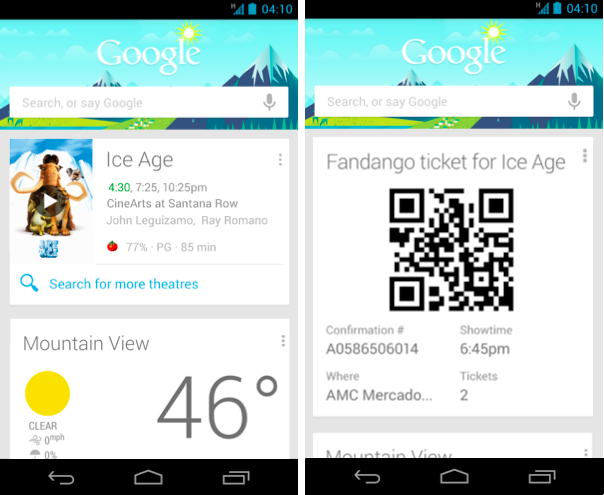
Going to the movies? Movie cards now include the latest ratings from Rotten Tomatoes, so you can pick the right movie. Purchase your tickets through Fandango, and Google Now will remind you when you need to leave for the theater, and pull up your tickets once you arrive.


In the market for a new home? Google Now can provide you with nearby real estate listings from Zillow. Plus, when you are checking out that remodeled kitchen at the open house, Now will automatically pull up more information about the listing.


Of course, all of this information is most helpful when it’s front and center and ready when you are. The new Google Now widget brings all your important Now cards to your home or lock screen, so you don’t even have to open the app.


When Google Now first launched last summer, we promised it was just the beginning, and it would continue to get better at delivering you more of the information you need, before you even ask. This is the fourth update since launch, and we’re just getting started!
To try out these new cards, get the latest version of the Google Search app for Android, available on Google Play for devices running Android 4.1 and above.